
Hot Desking for Freelancers Why Working From Home Is Not Enough

You chose freelance life for the freedom. No boss hovering. No commute playlist on repeat. No sad pantry biscuits that taste like cardboard with ambition.
Then reality appears.
Your third video call of the day happens at the kitchen table. Your neighbour starts drilling at exactly the moment you say, “Let me walk you through the proposal.” Your fridge becomes your most consistent colleague. By 4 pm, you are somehow both exhausted and under-stimulated, which feels illegal but is very real.
Working from home can be great. It can also turn into a soft, pants-optional productivity swamp.
That is where hot desking gets misunderstood. Too many freelancers think a hot desk is just “paying for a table”. It is not. Done right, it gives your workday structure, separation, people, and a professional setting without locking you into a full office lease.
In other words, it is not a fancy chair. It is a reset button.

Home is where productivity goes to die
Home has many talents. It is where you rest, eat, doom-scroll, water a plant badly, and wonder why there are three unopened bottles of soy sauce in the fridge.
It is not always where your brain does its best work.
The problem is not laziness. Most freelancers are already juggling client work, admin, sales, invoices, revisions, planning, and the quiet fear that an email titled “quick question” will ruin their afternoon.
The real issue is environmental confusion.
At home, every object sends a different signal.
Your bed says, “Nap?”
Your laundry says, “Deal with me.”
Your kitchen says, “A snack would fix everything.”
Your sofa says, “Bring the laptop over, what could go wrong?”
Then, three hours later, you are half-working, half-watching a video about someone restoring a 90-year-old toaster.
A proper work environment gives your brain one clear message: this is where work happens.
That sounds simple because it is. Simple does not mean small. The walk to a hot desk, the act of sitting down, the people quietly working around you, and the lack of household chores all create a mental boundary.
Freelancers often try to solve this with productivity apps. Timers. Blockers. Colour-coded calendars. A to-do list so intense it deserves its own HR department.
Those tools help, but they cannot fix a room that keeps whispering, “Your bedsheet needs changing.”
Cafés are a trap dressed up as a solution
Cafés feel like the perfect middle ground at first.
There is background noise. There is caffeine. There are other humans. Nobody asks why you are wearing the same T-shirt you wore yesterday, which is kind.
Then the cracks show.
You need to take a client call, but the table beside you has chosen that exact moment to debate travel plans at full volume. Your laptop battery drops to 12 percent. The only power socket is behind a man who has clearly built a permanent settlement there. The Wi-Fi works until it does not, which is the most Singapore café sentence ever.
Also, let us be honest: buying one flat white does not entitle anyone to occupy a four-seater table for half a workday. The internal guilt alone is enough to drain your battery before your MacBook does.
Cafés are wonderful for breaks, light admin, and pretending you are the main character in a productivity montage. They are less wonderful for:
Client calls
Deep work
Confidential tasks
Long writing sessions
Anything involving stable Wi-Fi
Not spilling coffee near a device that costs more than your last holiday
A hot desk gives you the café benefits without the café chaos. You get a change of scenery, people around you, and access to basic work needs like power, seating, and a call-friendly setup.
That is the unglamorous magic. You are not hunting for sockets like a stressed meerkat. You are just working.

Isolation quietly taxies your thinking
Freelancing can make you weirdly efficient and weirdly lonely at the same time.
You can deliver a project, send invoices, respond to leads, and fix your own printer issue before lunch. Impressive. Slightly heroic. Also, a little feral.
The isolation sneaks in slowly. At first, it feels peaceful. No interruptions. No office gossip. No one microwaving fish.
Then you realise you miss tiny work moments.
A quick sanity check.
A casual chat that sparks an idea.
A nod from someone also trying to survive Monday.
A five-minute conversation that reminds you there is a world outside your inbox.
This matters because creative and strategic work improves when your brain gets fresh input. You do not need constant collaboration. You do need occasional human contact that is not a client asking whether the deadline can be “brought forward slightly”.
Hot desking gives you light social contact without forcing you into a group project against your will.
That is the sweet spot.
You can keep your independence while still being around people who are also building, designing, coding, writing, selling, hiring, pitching, or figuring out why accounting software has chosen violence.
For early-stage founders, this can be especially useful. A small team may not need a full office yet, but working from bedrooms and cafés can make the business feel temporary. A shared work setting adds rhythm and seriousness without a long lease.
For remote employees, it solves a different problem. If your company is elsewhere but your body is firmly in Singapore, a hot desk can give you a neutral place to work that is neither your dining table nor the noisy café downstairs.
Your professional image should not rely on hope and noise cancellation
There are only so many times you can say, “Sorry, my dog is barking,” before it becomes part of your brand without your consent.
Clients notice the small things.
A messy background.
Unstable audio.
A call that drops twice.
Construction noise.
The delivery rider ringing the bell during pricing discussions.
None of this makes you bad at your job. Life happens. Still, professional trust is built through repeated signals. Your work matters most, yes, but the way you show up affects how people judge that work.
A clean, stable, work-appropriate setting helps you sound and feel more composed. It reduces the little frictions that make calls clumsy. It also helps you switch into a more confident mode.
The funny thing about “looking professional” is that it often changes how you behave too. Sit somewhere designed for work and you tend to work like someone who charges properly, answers clearly, and does not apologise for existing.
That is useful. Especially when quoting fees.
What a hot desk actually fixes
A hot desk is not a miracle cure. It will not write your proposal, chase your overdue invoice, or stop clients from saying “Can we make it pop?”
What it does fix is the workday container.
It gives your day a place to live.

It creates a start and stop line
When the workplace is your bedroom, work bleeds everywhere. You check one message after dinner. Then another. Then suddenly it is 11:48 pm and you are editing a deck while your brain files a complaint.
Going somewhere to work creates a natural ritual.
Arrive. Set up. Work.
Pack up. Leave. Stop.
That boundary is underrated. It protects your focus during work hours and your rest after them. Freelancers often struggle with both.
It removes tiny daily decisions
Where should I sit?
Is the Wi-Fi good?
Can I take a call?
Will there be a socket?
Do I need to buy another drink?
Is this table too close to the toilet?
These decisions seem small, but they nibble at your attention like tiny productivity mosquitoes.
A good hot desk removes the drama. You show up and work. That is the point.
It makes deep work easier
Deep work needs fewer interruptions and a setting that supports concentration. At home, the interruption might be laundry. At a café, it might be the blender achieving lift-off.
At a hot desk, the background gives quiet pressure. Other people are working, so your brain gets the hint. It is like going to the gym, except the main muscle is your ability to not open YouTube.
It gives your week rhythm
You do not need to hot desk every day.
Some people use it two or three times a week for heavy work. Others use it on client call days. Founders may use it when the team needs to sit together for planning or hiring chats. Remote employees may use it when home starts feeling like a padded cell with better snacks.
The point is to match the space to your work.
A simple weekly pattern might look like this:
Workday need | Best setting |
Admin, light emails, simple edits | Home |
Deep work, writing, planning, client calls | Hot desk |
Casual thinking, short break, reading | Café |
Team alignment or project push | Shared workspace |
No single place has to carry your entire work life. That is the mistake.
The math is less scary than it looks
A lot of freelancers reject hot desking because they assume it is expensive.
Fair concern. Nobody went freelance to collect recurring costs like Pokémon.
But compare it with the real cost of café-working.
A coffee here, lunch there, one more drink because you have been occupying the table since breakfast. Add transport, patchy productivity, and the occasional wasted afternoon because the Wi-Fi gave up spiritually.
Suddenly, the “cheap” option looks less cheap.
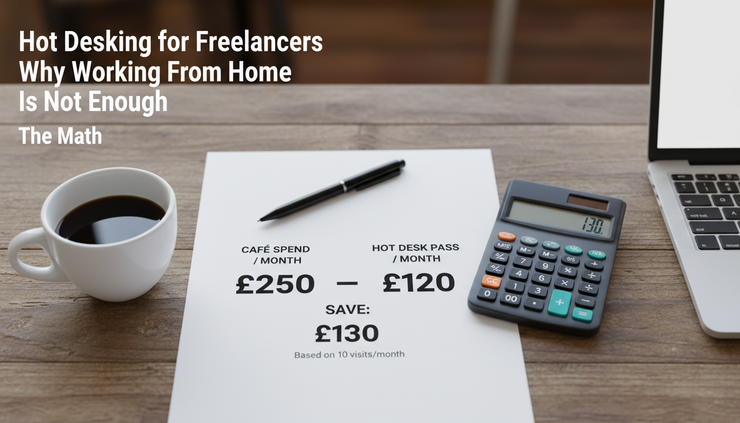
If you have searched for Hot desk Singapore, you have probably seen a wide range of pricing and access options. Some spaces offer day passes. Some offer flexible bundles. Some are built for teams, while others suit solo workers who just need a reliable seat and fewer domestic distractions.
The phrase Hot desk Singapore $25 also pops up because many people are not looking for luxury. They want a practical, affordable place to work for the day.
That is the right instinct. The goal is not to rent a throne. The goal is to buy back focus.
When comparing options, look beyond the headline price. Ask:
Is Wi-Fi included and reliable?
Are there enough power points?
Can you take calls without becoming the villain?
Is the location easy to reach by MRT or bus?
Are the hours useful for your schedule?
Does the space feel calm enough for real work?
Can you book only when you need it?
The cheapest seat is not always the best value. The best value is the one that helps you finish work faster, present yourself better, and leave with your brain still intact.
How to use a hot desk without recreating the office you escaped
The fear is understandable. Freelancers left fixed office life for a reason. Nobody wants to swap home chaos for a rigid routine where the chair squeaks and someone judges your lunch.
So do not use hot desking like a full-time office unless that suits you.
Use it like a tool.
Choose your hot desk days with intent
Do not go just because you feel guilty. Go when the environment will change the outcome.
Good hot desk days include:
Proposal writing
Client calls
Strategy work
Hiring or founder planning
Complex edits
Financial admin
Any task you have avoided for three days while blaming “vibes”
Bad hot desk days might include sleepy admin, low-energy tasks, or work you can finish easily from home.
Pack like someone who respects future you
A small work kit makes the day smoother.
Bring your charger, earphones, water bottle, notebook, and any adapter your laptop demands like a tiny diva. If calls are on the schedule, bring a mic or headset that does not make you sound like you are broadcasting from a biscuit tin.
Future you will be grateful. Future you may even finish early.
Treat the space like a focus zone
Hot desking works best when you arrive with a plan.
Pick one to three important tasks before you sit down. Not seventeen. Seventeen tasks is not a plan, it is a cry for help in bullet form.
Start with the work that needs the most brainpower. Save messages and admin for later. The space gives you the conditions. You still need to point your attention in the right direction.
Talk to people, but do not become the pantry goblin
One bonus of hot desking is being around other people. Say hello. Have a short chat. Ask what someone is working on if the moment feels natural.
Then get back to work.
The goal is light connection, not accidentally hosting a three-hour TED Talk beside the printer.
FAQ
Is hot desking worth it for freelancers?
Yes, if your current setup hurts your focus, calls, or routine. It is especially useful for deep work, client meetings, and days when home feels too distracting.
Do I need a hot desk every day?
No. Many freelancers only need it a few days a week. Use it for work that needs concentration, structure, or a more professional setting.
Is a café cheaper than a hot desk?
Sometimes, for a short session. For a full workday, café costs can add up through drinks, food, weak Wi-Fi, and lost focus. A hot desk may offer better value if it helps you finish work properly.
Can remote employees use hot desks too?
Yes. A hot desk can help remote employees separate work from home, improve call quality, and add routine without renting a private office.
What should I look for in a hot desk?
Look for reliable Wi-Fi, power points, comfortable seating, call-friendly areas, easy transport access, fair pricing, and a calm atmosphere.

Working from home is useful, but it should not be the whole plan
Freelance freedom should feel like choice, not like being trapped between a fridge and a dying laptop battery.
Home has a role. Cafés have a role. A hot desk has a role too. The mistake is expecting one environment to support every kind of work, every day, forever.
If work has started to feel blurry, lonely, or weirdly harder than it should, the problem may not be your discipline. It may be the room.
Change the room, and the work often changes with it.


Comments